African vs South American Cichlids: Picking Your Tank
African vs South American cichlids — tank size, water chemistry, aggression, common species. Pick the right region before buying.
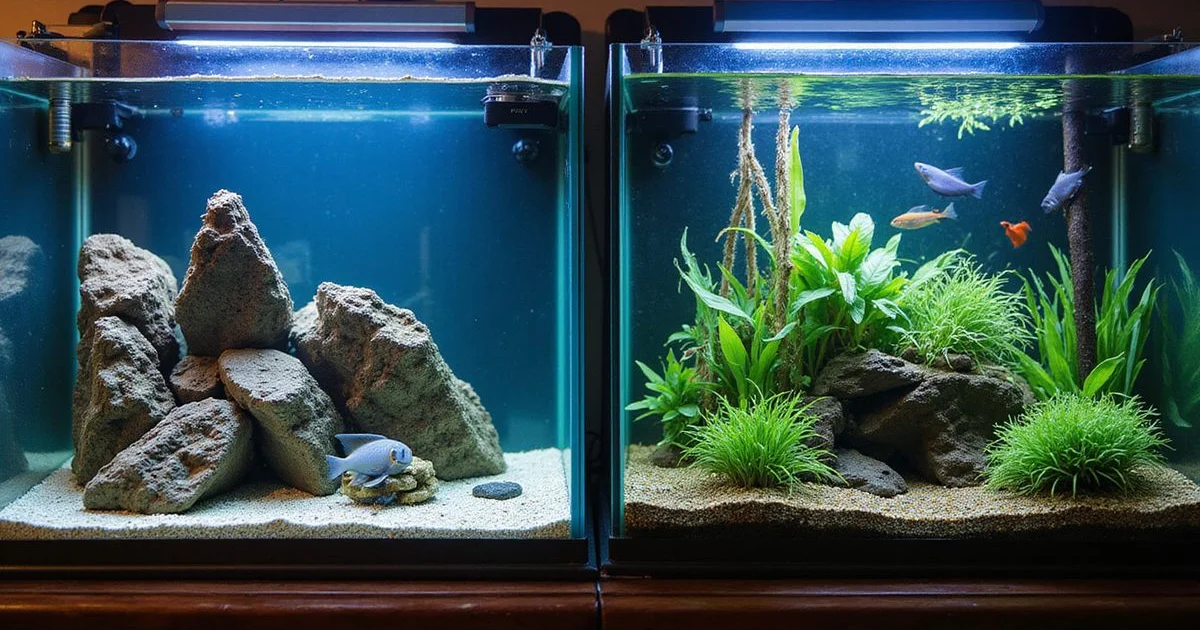
For a related deep dive, read our African cichlid water chemistry. We often see business owners and homeowners struggle with their first cichlid display tank. Picking the wrong fish region before buying rocks or livestock usually leads to expensive mistakes.
Comparing african vs south american cichlids is the critical first step.
The key is understanding that these fish require completely different environments. If you want a thriving setup, start with our parent guide to Cichlids.
We are going to break down the size, water, and behavioral differences to help you pick the right region. This guide will look at how to match your local tap water to the best possible fish species.
Tank size and aggression differences (Mbuna often more aggressive than peacocks; oscars need 75g+ alone)
We always warn clients that Mbuna need 55-gallon colony setups to manage high aggression, while a single predatory Oscar requires a 75-gallon tank minimum. Aggression levels and sheer adult size will entirely dictate your tank dimensions.
A single South American Oscar can grow up to 14 inches long and requires an enormous amount of space. If you want to add tank mates for an Oscar, current 2026 guidelines recommend stepping up to a 125-gallon or 150-gallon aquarium.
Our team recommends a strategy of “controlled overstocking” for African Mbunas to spread out their territorial aggression. This technique forces the fish to share space, but it demands a heavy-duty filtration system to handle the massive bio-load.
| Region / Type | Average Adult Size | Minimum Tank Size | Aggression Level |
|---|---|---|---|
| African (Mbuna) | 4-6 inches | 55 gallons (colony) | Highly Territorial |
| African (Peacock) | 5-7 inches | 55-75 gallons | Moderately Aggressive |
| South American (Oscar) | 12-14 inches | 75 gallons (single) | Predatory / Aggressive |
| South American (Ram) | 2-3 inches | 20 gallons | Peaceful |
Managing Cichlid Aggression
African Peacocks, formally known as Aulonocara species, offer a slightly calmer alternative to the chaotic Mbuna. They still need plenty of swimming space, so a 55-gallon tank is the baseline for a small group.
Our experience shows that providing plenty of rocky hiding spots helps subordinate fish escape bullies. South American cichlids vary wildly in temperament across different species.
Dwarf species like the German Blue Ram are peaceful community fish, while a Green Terror will dominate a tank. Always confirm the specific adult size of your chosen species before finalizing your tank dimensions.
Water chemistry differences (hard alkaline African vs soft acidic South American)
The absolute most critical distinction between these two regions is their required water chemistry. African cichlids thrive in hard, alkaline water (pH 7.7-8.6), while South American species prefer soft, acidic conditions (pH 6.0-7.0).
We test tap water across the US daily, and many municipal water supplies sit around a neutral pH of 7.0. Lake Malawi African cichlids naturally need a high pH ranging from 7.7 to 8.6 to survive.
They also require incredibly hard water, specifically a General Hardness (GH) of 160 to 280 ppm. To maintain these high alkaline levels, our service technicians often use crushed coral substrate or commercial buffers like Seachem Cichlid Lake Salt.
Here is a quick look at the target water parameters:
- African (Lake Malawi): pH 7.7 to 8.6, GH 160-280 ppm.
- African (Lake Tanganyika): pH 8.0 to 9.0, GH 200-300 ppm.
- South American (Amazon Basin): pH 6.0 to 7.0, GH 50-150 ppm.
- Dwarf South American (Apistogramma): pH 5.5 to 6.5, very soft water.
Matching Your Tap Water
We highly recommend choosing a fish that naturally matches your local tap water chemistry. Fighting your water supply with constant chemical additives is a frustrating and expensive battle.
If your city water comes out at a pH of 8.0, an African cichlid setup will save you endless maintenance hours. Our most successful client tanks rely on stability rather than hitting a mathematically perfect pH number.
Driftwood naturally leaches tannins that safely soften the water. This makes it a perfect functional decoration for a South American biotope.
Common species per region
African setups commonly feature colorful, hyperactive Mbuna and Peacocks, while South American tanks highlight large centerpiece fish like Angelfish and Oscars. Choosing your fish comes down to the specific visual style and activity level you want for your space.
We frequently stock Electric Yellow Cichlids, a popular Mbuna, because their bright coloration rivals marine fish. Lake Malawi is home to three main groups.
These groups include the rock-dwelling Mbuna, the open-water Haps, and the bottom-foraging Peacocks. Cyrtocara moorii, a stunning blue Hap, is often featured in our display tanks to create a beautiful focal point.
| Region | Popular Species | Key Characteristic | Typical Diet |
|---|---|---|---|
| African | Electric Yellow (Mbuna) | Bright yellow, highly active | Omnivore / Herbivore |
| African | Red Rubin (Peacock) | Metallic colors, sand-sifter | Carnivore / Omnivore |
| South American | Angelfish (Pterophyllum) | Tall, graceful fins | Omnivore |
| South American | Geophagus | Constant sand shifting | Omnivore |
Popular South American Choices
South American cichlids offer everything from tiny jewels to massive aquatic pets. The classic Angelfish is a South American native that looks stunning in a tall office lobby aquarium.
We also design many setups around Geophagus species. These fascinating fish are known as “earth eaters” because they constantly sift sand through their gills.
Dwarf options like the Apistogramma top out around three inches and are perfect for a heavily planted 20-gallon home tank. Our team always advises clients that large Oscars are incredibly intelligent and will actually learn to recognize their owners.
Compatibility within each group, and why you don’t mix african vs south american cichlids
Never mix these two distinct regions in the same aquarium. Their completely conflicting water chemistry needs and behavioral languages make cohabitation impossible.
We have seen countless mixed tanks fail because one group is always suffering in the wrong pH range. Beyond water parameters, their communication styles are fundamentally different.
A South American fish might interpret a territorial display from an African Mbuna as a simple greeting, leading to disastrous consequences. Our strict quarantine process keeps these groups separated to prevent the cross-contamination of region-specific pathogens.
Mixing the two regions leads to several guaranteed failures:
- Pathogen Susceptibility: African cichlids have no natural immunity to common Amazonian parasites.
- Dietary Clashes: Herbivorous Mbuna will develop fatal bloat if fed the high-protein diet required by Oscars.
- Environmental Stress: South American fish kept in hard, alkaline water will suffer kidney failure.
- Communication Breakdown: Their territorial warning signs do not translate across regions.
Managing Same-Region Tanks
Even within the same region, you must carefully select compatible tank mates. Mixing an aggressive South American Red Devil with a peaceful fish is a recipe for disaster.
We always group fish by their adult size and natural dietary needs. For African setups, mixing Peacocks and Mbuna is generally discouraged because the hyperactive Mbuna will outcompete the Peacocks for food.
Our staff recommends sticking to a single lake biotope for the highest success rate. Creating a dedicated Lake Tanganyika tank is much easier to manage than a mixed African setup.
Which region suits planted tanks (South American often friendlier to plants)
If you want a lush, heavily planted aquarium, South American cichlids are the clear winner. Many African species are aggressive diggers and voracious herbivores that will destroy your aquascape.
We love designing planted tanks around Dwarf South American species like Bolivian Rams or Apistogrammas. These small fish thrive among the roots of Amazon Swords and actually use the broad leaves for breeding sites.
Our aquarium technicians use nutrient-rich soil substrates for these setups to guarantee explosive plant growth. This approach creates a beautiful, natural ecosystem right in your living room.
Best plants for South American Cichlid tanks:
- Amazon Swords (Echinodorus): Broad leaves provide excellent cover.
- Java Fern (Microsorum pteropus): Tough leaves that resist nibbling.
- Anubias Barteri: Can be attached directly to driftwood to protect roots.
- Cryptocoryne: Excellent for creating dense, low-level foregrounds.
The African Cichlid Plant Challenge
Keeping live plants with African cichlids is incredibly difficult, but not entirely impossible. The notorious Mbuna will treat most delicate stem plants as an expensive salad bar.
We occasionally successfully use floating plants like Hornwort because they grow rapidly and cannot be uprooted. Hardy plants like Anubias can survive if you firmly glue or tie them directly to heavy rocks.
Our best advice for African tanks is to rely on porous limestone and a sandy substrate for your primary visual structure. The fish provide all the color and movement you will ever need.
Our Sarasota store at 2847 Bee Ridge Road is built for hobbyists who want real answers, not sales pressure. Marcus Chen opened Gulf Coast Aquatics in 2019 after 25+ years in the hobby and years managing big-box aquarium departments.
Every fish is quarantined two weeks. Every saltwater species gets reef-safe labeling.
We will always be honest with our customers. If your water chemistry is off, our staff will tell you before you buy livestock.
If you are here because you are a cichlid-curious buyer doing a cichlid comparison before committing to a tank setup, you are in the right place to learn about african vs south american cichlids.
Bring a water sample anytime for free testing. We test ammonia, nitrite, nitrate, pH, alkalinity, calcium, magnesium, and salinity for marine tanks.
Results take about ten minutes. Our team will explain what is likely driving your issue in plain language.
)
Practical next steps
- Test your water (free in store, see our free water testing page).
- Match livestock to your actual parameters, not forum guesses.
- Ask us before you buy, and our team will tell you if something won’t work in your tank.
Visit Gulf Coast Aquatics
2847 Bee Ridge Road, Sarasota FL 34239 · (941) 555-0178 · Open Mon-Sat 10-6, Sun 12-5.
Frequently asked questions
Are South American cichlids easier than African? ▼
Generally yes — softer water more forgiving, less species-specific aggression, and many work in planted tanks.
What's the smallest African cichlid tank? ▼
55 gallons minimum for Mbuna — they need rock work and swimming room to spread aggression.
Can I keep just one big cichlid? ▼
Yes — single oscar or single Jaguar setups work in 75g+ and avoid all aggression questions.
Ready for the next step?
Browse our Cichlids selection in store or ask us in person at Bee Ridge Road.
View Cichlids