FOWLR vs Reef Tank: Where to Start
Fish-only with live rock (FOWLR) vs reef tank — equipment, cost, parameter stability, livestock flexibility, and upgrading later.
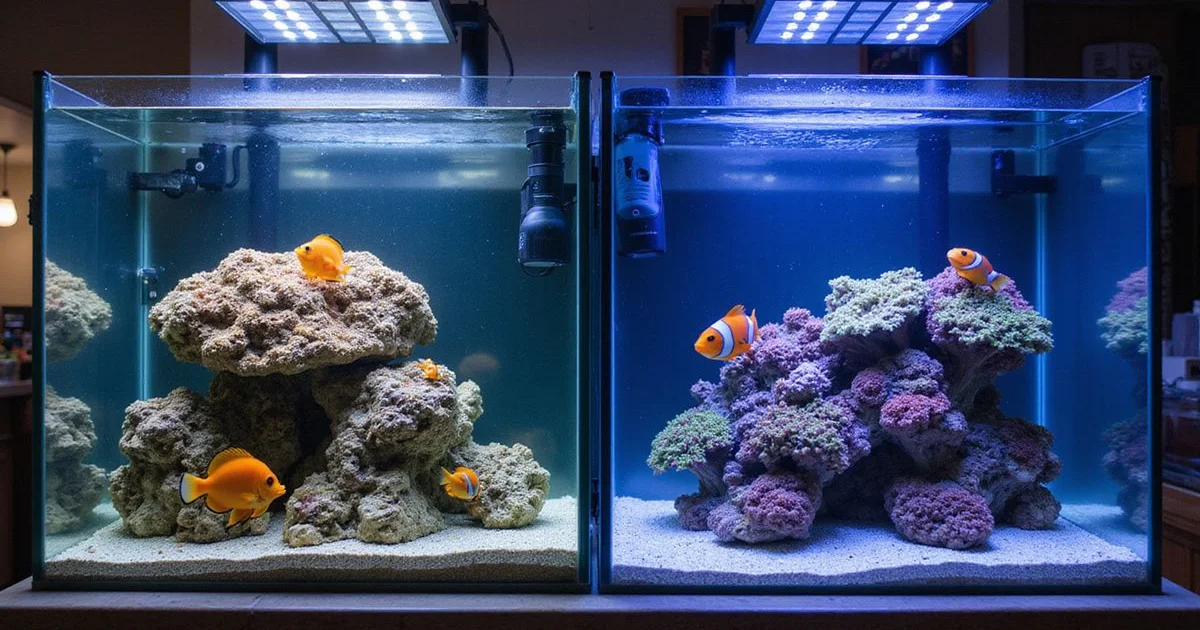
For a related deep dive, read our reef-safe saltwater fish guide. We see plenty of homeowners and business owners waste thousands of dollars on the wrong first aquarium. The choice between a basic marine tank and a full coral setup dictates every piece of equipment you buy.
We always suggest you start with our parent guide: Saltwater Fish.
This resource covers the biology basics before you spend a dime. Our immediate goal here is to help beginners pick the right starting setup without buying twice.
Most people do not realize how quickly a single coral fragment changes the required daily maintenance schedule. We are going to break down the true 2026 costs, the specific hardware differences, and the fish you can keep in each system.
The facts reveal important distinctions about these systems, so here are practical ways to start your build.
Equipment differences
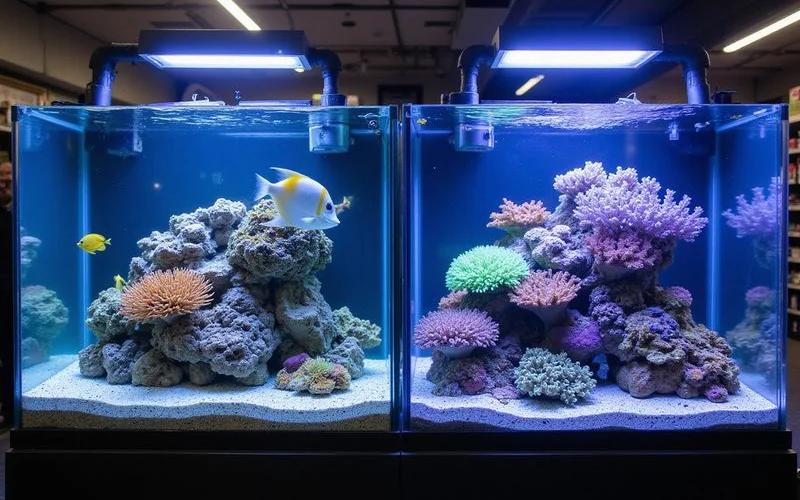
A reef tank requires high-intensity lighting, a Reverse Osmosis Deionization (RO/DI) system, and strong wavemakers to keep corals alive. We often see beginners fail because they try to use standard freshwater gear for marine environments.
A Fish Only With Live Rock (FOWLR) system only needs basic filtration and standard LED lights to illuminate the fish. Our technicians consider the RO/DI filter the most critical difference between the two setups.
Tap water contains heavy metals and chloramines that will quickly kill delicate coral fragments. We install BRS 4-Stage RO/DI units on nearly every reef build to ensure zero Total Dissolved Solids.
Essential Hardware Breakdown
| Equipment | FOWLR Tank | Reef Tank |
|---|---|---|
| Lighting | Basic LED ($50-$100) | High PAR LED like AI Prime 16HD ($250+) |
| Water Source | Conditioned tap water (sometimes acceptable) | Strictly RO/DI water required |
| Water Flow | Standard return pump | Variable wavemakers (e.g., Nero 5) |
| Filtration | Basic mechanical and biological | Protein skimmer highly recommended |
The Impact of Coral Lighting
The lighting demands create a massive divide in your initial hardware list. Our team recommends high PAR (Photosynthetically Active Radiation) fixtures for any coral growth.
Brands like AquaIllumination and Kessil engineer specific spectrums that mimic natural sunlight hitting the ocean floor. We stock these advanced lights because corals rely on them for photosynthesis and survival.
Standard marine setups skip this intensity entirely, saving you hundreds of dollars upfront.
Cost differences
Our average 2026 calculation for a starter FOWLR tank sits at $500 to $1,000, while a basic reef setup ranges from $1,000 to $2,500. The price gap comes directly from the specialized lighting, water filtration, and expensive testing kits required for corals.
We regularly price out 40-gallon breeder tanks to show customers the true financial commitment. A basic glass tank costs around $135, but the supporting gear multiplies that base price rapidly.
Our maintenance staff always warns clients about the hidden ongoing costs of marine systems.
Upfront Hardware Investments
High-end lighting for photosynthesis easily adds $300 to $600 to your initial receipt. We install digital Hanna Checkers for testing, which cost around $50 to $70 per parameter.
Live rock currently retails for $5 to $15 per pound, meaning a 50-gallon tank requires up to $500 just for the biological foundation. Our experts suggest dry rock as a budget option, though it takes months to establish beneficial bacteria.
You must also budget for premium salt mix, which runs about $30 a box.
Ongoing Monthly Maintenance Fees
We estimate the monthly running cost for electricity, food, and supplements hits $75 to $200 depending on tank size. Reef aquariums demand regular dosing of alkalinity, calcium, and magnesium liquids to keep parameters stable.
Our clients usually spend $20 a month just on these specific mineral supplements. Fish-only tanks skip these chemical additives entirely, keeping your monthly budget closer to $50.
- Salt Mix: $15 to $40 per month for water changes.
- RO/DI Water: $10 to $30 if you purchase from a local fish store.
- Chemical Supplements: $10 to $30 for calcium and alkalinity dosing.
- Electricity: $10 to $50 depending on the power draw of your lights and pumps.
We help customers build a realistic budget before they purchase a single glass pane.
Parameter stability requirements (corals far less forgiving)
Corals require strict stability across alkalinity, calcium, and magnesium, whereas fish can tolerate minor water chemistry fluctuations. We monitor reef systems daily because a sudden drop in alkalinity can wipe out hundreds of dollars of livestock overnight.
Hard corals consume minerals rapidly to build their calcium carbonate skeletons. Our service route includes testing these big three parameters to prevent sudden crashes.
A FOWLR system mainly requires you to watch standard ammonia, nitrite, and nitrate levels. We recommend keeping reef alkalinity strictly between 8 and 12 dKH.
Calcium must stay balanced around 420 to 440 ppm for healthy growth. Our preferred target for magnesium sits comfortably at 1350 ppm.
You will need digital testers, like the Hanna Checkers mentioned earlier, to hit these precise numbers accurately. We see many new hobbyists stress over these metrics during their first year.
A simple marine tank removes this anxiety completely, letting you enjoy the animals without acting as a full-time chemist.
| Parameter | Reef Target | FOWLR Target |
|---|---|---|
| Alkalinity | 8-12 dKH (Strict) | 7-10 dKH (Flexible) |
| Calcium | 420-440 ppm (Strict) | Not critical for fish |
| Magnesium | 1300-1350 ppm (Strict) | Not critical for fish |
| Nitrate | Under 10 ppm | Tolerable up to 30-40 ppm |
Our testing logs prove that fish-only environments are drastically easier to manage for beginners. Frequent water changes usually handle all the chemistry needs for a basic setup.
Livestock flexibility: FOWLR opens up coral-eating species (angels, puffers)
We love FOWLR tanks because they allow you to keep charismatic predators like Porcupine Puffers and Clown Triggers that would eat expensive corals. These larger fish possess strong jaws designed to crush hard shells and graze on reef structures.
Our staff always warns buyers that a beautiful Emperor Angelfish will quickly decimate a $200 Zoanthid fragment. A fish-only environment removes this restriction entirely.
Top Fish for FOWLR Systems
We frequently stock several incredible species that require a strictly fish-only home. The exact list of coral-eaters includes some of the most vibrant fish in the ocean.
- Panther Grouper: Grows very fast and requires heavy filtration due to its messy eating habits.
- Dogface Puffer: Displays an incredible personality and will often hand-feed like a puppy.
- Butterflyfish: Features stunning yellow and white patterns but naturally feeds on coral polyps in the wild.
- Harlequin Tuskfish: Adds vibrant blue and orange colors to the display while aggressively hunting small invertebrates.
Our clients absolutely adore these fish for their unique behaviors. A predator tank does require a massive protein skimmer to handle the high bioload.
We install oversized filtration on these setups to process the heavy waste produced by carnivorous diets. These messy eaters will cause nitrate spikes if the biological filter cannot keep up.
Our team advises buying a tank over 100 gallons if you plan to keep these specific animals long-term.
How to upgrade from FOWLR to reef later without buying everything twice
The smartest way to upgrade later is to buy a “reef-ready” tank drilled for a sump from day one. We help clients plan their initial purchase so they only need to add a better light and a protein skimmer down the road.
Starting with a sump gives you a hidden compartment to store all future hardware. Our standard build strategy uses high-quality dry rock that functions perfectly for fish now and serves as a coral foundation later.
A budget All-In-One tank limits your ability to add advanced reactors or oversized skimmers. We suggest avoiding cheap canister filters if you have any intention of keeping soft or hard corals eventually.
You can easily swap a basic $50 LED bar for a $300 AquaIllumination Prime when you feel ready. Our shop actually credits customers for their old equipment when they upgrade through our trade-in program.
This phased approach spreads the financial hit out over several years.
- Phase 1 (Months 1-6): Master basic water quality with fish and standard rock.
- Phase 2 (Months 6-12): Upgrade the lighting fixture to a high PAR unit.
- Phase 3 (Year 1+): Introduce a protein skimmer and start testing alkalinity.
- Phase 4: Add your first hardy soft corals like Green Star Polyps or Leather Corals.
We see fantastic success rates with hobbyists who follow this exact timeline.
Practical next steps
Testing your water regularly provides the data needed to make smart decisions about your next purchase. We offer this service completely free in our store, and you can see the details on our free water testing page.
Matching livestock to your actual parameters prevents unnecessary fish loss and saves you money. Our staff relies on hard numbers rather than forum guesses to diagnose tank issues.
A simple conversation with a professional will reveal if a specific fish will thrive in your tank. We will tell you directly if a species requires a different setup before you make a mistake.
Visit Gulf Coast Aquatics
The Sarasota store at 2847 Bee Ridge Road is built for hobbyists who want real answers, instead of sales pressure. We operate Gulf Coast Aquatics with a focus on education, backed by Marcus Chen’s 25 years of hands-on marine experience.
Every fish in the building goes through a strict two-week quarantine process before hitting the sales floor. Our labeling system clearly marks every saltwater species as reef-safe or strictly fish-only.
A quick water chemistry check takes about ten minutes to process. We explain what is likely driving your water issue in plain language.
Bring a water sample anytime for a free check of ammonia, nitrite, nitrate, pH, alkalinity, calcium, magnesium, and salinity. Our doors are open Monday through Saturday from 10 to 6, and Sunday from 12 to 5.
You can reach the shop directly at (941) 555-0178 to speak with a technician today.
Frequently asked questions
Can I add corals to my FOWLR later? ▼
Yes — if you built FOWLR with reef-quality lighting and RO/DI from day one, the upgrade is mostly livestock.
Is FOWLR boring compared to reef? ▼
Not at all — FOWLR opens up large angels, puffers, triggers you can't keep in a reef.
What's the cheapest stable reef I can build? ▼
A 20-40g all-in-one (NUVO, Red Sea) with softies and a couple LPS runs ~$1,500 fully stocked.
Ready for the next step?
Browse our Saltwater Fish selection in store or ask us in person at Bee Ridge Road.
View Saltwater Fish