Aquascaping a Community Tank: How Layout Stops Aggression
How to aquascape a freshwater community tank — line-of-sight breaks, caves, driftwood, plants, and layouts for community vs cichlid setups.
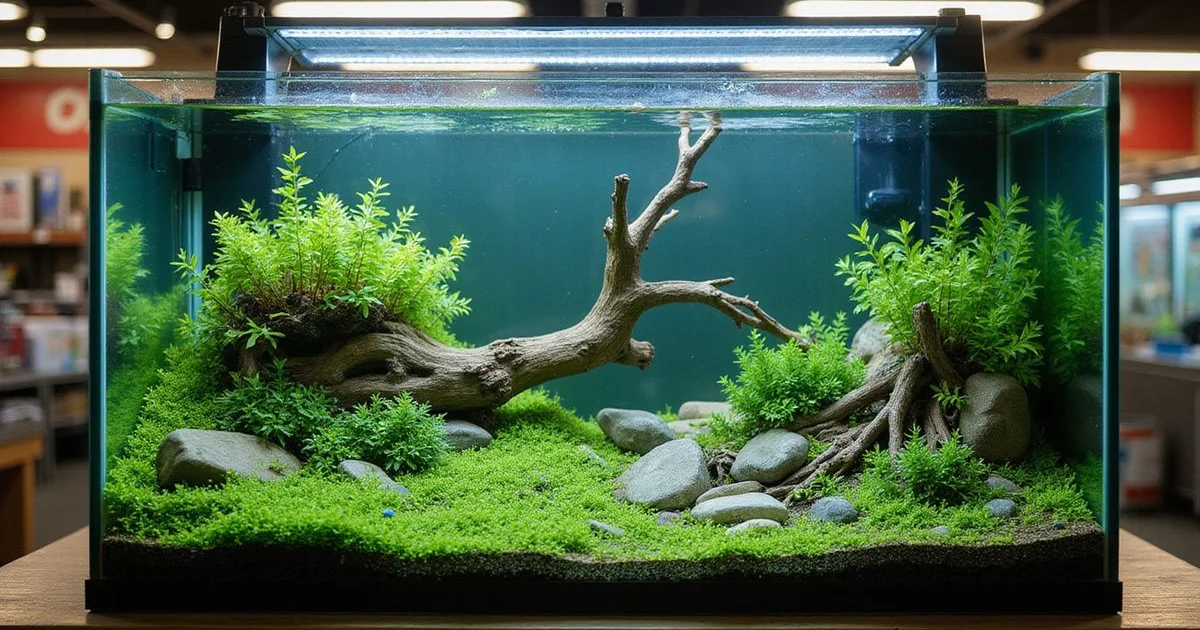
For a related deep dive, read our freshwater fish compatibility guide. We know exactly how frustrating it is when a beautiful new tank turns into a battleground. When aquascaping a freshwater community tank, poor layout choices are actually the leading cause of aggression, often overshadowing water quality issues. This dynamic transforms a relaxing display into a stressful environment for both the fish and the property owner.
Our team relies on strategic freshwater aquascaping to naturally stop territorial disputes before they start.
Let’s look at the structural layout mechanics that prevent fighting. You can start by reviewing the basic compatibility rules in the parent guide on Freshwater Tropical Fish. We will break down specific hardscape, plant, and substrate choices that keep your residential or office tank perfectly balanced.
Territory and line-of-sight breaking: why open tanks have more aggression
Open tanks create a “gladiator arena” effect where dominant fish can constantly see and chase their targets across the water column. You must break the line of sight using tall vertical elements to physically block these aggressive visual triggers.
Our experts see this mistake constantly in large US office aquariums. A 2026 guide from Rate My Fish Tank confirms that breaking this visual line is the single most important concept in reducing aggression.
Aggression-reducing layout tips:
- Create distinct zones: Use physical barriers to divide the tank into separate territories.
- Provide cave networks: Ensure there are multiple exits so fish cannot be cornered.
- Block the middle view: Place tall, bushy plants directly in the center to block vision from end to end.
- Use visual dividers: Tall rocks or dense wood structures stop fish from locking onto targets.
Subordinate fish need distinct escape routes and physical barriers to feel safe. We recommend building visual roadblocks in the middle third of the water column.
Placing a single small castle in the corner leaves too much open space for territory disputes. African Cichlid setups often require controlled overstocking paired with massive rock structures to spread out the aggression safely. Our aquascapers use tall driftwood pieces angled toward the surface to immediately disrupt line-of-sight issues.
Hardscape choices
The best hardscape choices for a community tank include Malaysian driftwood for plant attachment, porous lava rock for biological filtration, and dedicated caves. These elements provide crucial shelter while creating a stunning focal point for your home or business.
Our aquascapers always match the stone type to the specific fish species being kept. A May 2026 guide from Aqua Rocks Colorado warns that buying improperly scaled wood is the most common beginner mistake.
Dense materials like Malaysian and Mopani wood will sink almost immediately without needing to be weighted down. We carefully soak all new wood to manage the release of tannins.
| Material Type | Primary Benefit | Water Chemistry Impact | Best Use Case |
|---|---|---|---|
| Malaysian Driftwood | Excellent base for epiphytes | Lowers pH slightly | Planted community tanks |
| Mopani Wood | Highly dense and sinks instantly | Releases heavy tannins | Blackwater South American setups |
| Seiryu Rock | Creates striking mountain textures | Raises pH and hardness | African Cichlid or hard-water tanks |
| Lava Rock | Porous surface houses beneficial bacteria | Completely inert | Shrimp and sensitive fish tanks |
Mopani wood provides a rich, dark color but requires weeks of soaking if you want clear water. Seiryu rock contains calcium carbonate, making it dangerous for soft-water species like Neon Tetras.
Our inventory always labels these chemical impacts clearly. You can safely use inert lava rock in any setup because it will not alter your water parameters.
Aquatic plant basics: Java fern, anubias, cryptocoryne for low-light beginners
Low-light plants like Java fern, Anubias, and Cryptocoryne thrive in the 10 to 20 PAR range without needing expensive carbon dioxide injectors. These hardy species absorb excess nutrients from the water, which drastically reduces algae growth.
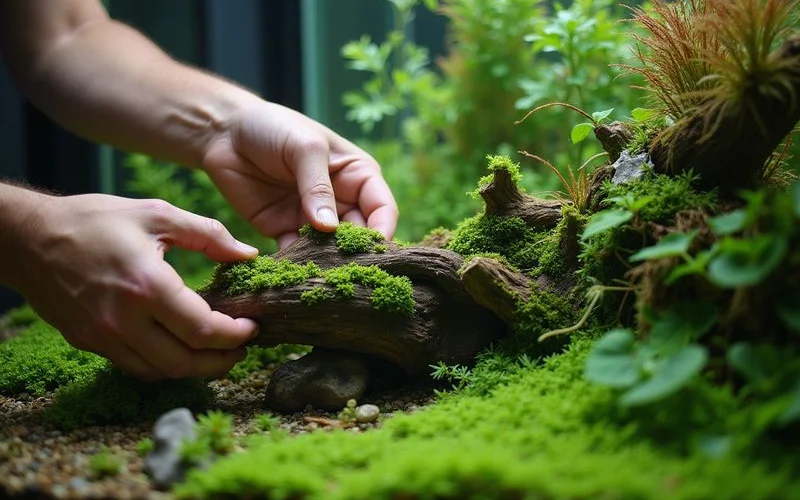
Our maintenance teams rely on these specific plants for low-hassle office displays. You must treat Anubias and Java Fern as epiphytes rather than traditional rooted plants.
Their thick rhizomes will literally suffocate and rot if you bury them under the substrate. We use standard cyanoacrylate super glue to attach them directly to hardscape surfaces.
Key low-light plant species:
- Java Fern (Microsorum pteropus): Attach to wood or rock to provide excellent tall, bushy cover that breaks the line of sight.
- Anubias Barteri: Features broad, tough leaves that even herbivorous fish avoid eating.
- Cryptocoryne Wendtii: A fantastic mid-ground plant that feeds heavily from the roots and thrives in low light.
Cryptocoryne wendtii acts differently and requires planting directly into a nutrient-rich bottom layer. The plant often experiences “crypt melt” when first introduced to a new tank, dropping all its leaves.
Our clients sometimes panic during this phase, but the roots remain alive and will sprout new growth within a few weeks. A quick trim of dead leaves speeds up this recovery process.
Substrate selection
The ideal substrate depends entirely on your plant and livestock goals, with options ranging from inert pool filter sand to active volcanic soils like Fluval Stratum. Choosing the wrong bottom layer will severely stunt plant growth or physically injure bottom-dwelling fish.
Our staff frequently replaces incorrect substrates for frustrated local customers. Fluval Stratum is a compressed volcanic soil that naturally lowers pH, making it perfect for soft-water fish and heavy root-feeding plants.
It provides massive growth potential but eventually breaks down into mud after roughly two years. We always recommend capping nutrient soils with a thin layer of sand to prevent messy water.
| Substrate Type | Average Cost (US) | Nutrient Level | Maintenance Level |
|---|---|---|---|
| Fluval Stratum (Aqua Soil) | $35 to $45 per 17.6 lbs | High | Low (No vacuuming needed) |
| Fine Sand | $10 to $20 per 50 lbs | Zero | Medium (Requires gentle surface sifting) |
| Standard Gravel | $15 to $25 per 20 lbs | Zero | High (Requires deep vacuuming) |
Standard gravel is inexpensive and easy to vacuum, but requires the manual addition of fertilizer root tabs to keep plants alive. Sand is absolutely mandatory if you keep Corydoras catfish or Geophagus species.
Sharp, rugged gravel will quickly erode their sensitive barbels and lead to serious bacterial infections. Our team suggests a fine, smooth sand layer of about two inches for these bottom-dwellers.
Layout examples
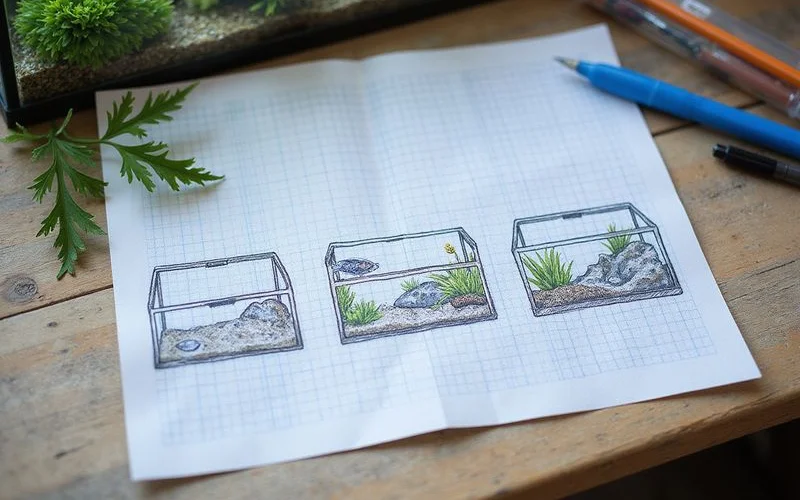
The three most successful layout templates are the standard community tank layout, the heavy-rock cichlid structure, and the natural biotope. Following one of these proven templates prevents visual clutter and ensures the habitat matches the behavioral needs of the specific fish.
Our designs usually start with the standard community layout using the “Rule of Thirds” principle. You place the primary visual focal point slightly off-center to create a natural, flowing look that leaves open swimming space in the middle.
Layout templates to consider:
- The Community Flow: Off-center focus using the rule of thirds, with tall background plants and open swimming areas in the front.
- The Cichlid Fortress: Dense, stacked limestone creating endless caves, specifically designed to buffer pH and diffuse aggression.
- The Amazon Biotope: Dim lighting, scattered leaf litter, and dark water meant to soothe easily stressed tetras and discus.
African Cichlid setups demand a completely different approach based on structural density. We stack heavy limestone or Texas Holey Rock high into the water column to provide dozens of defensible caves.
This dense rock work actively buffers the pH above 8.0 to mimic the hard water of the African rift lakes. A South American blackwater biotope provides a specialized environment for species like Discus or Tetras.
Our biotope installations utilize dim lighting, heavy Indian Almond leaf litter, and downward-pointing branches. This mimics the flooded Amazon basin and provides incredible stress relief for sensitive species.
Our Sarasota store at 2847 Bee Ridge Road is built for hobbyists who want real answers, not high-pressure sales pitches. Marcus Chen opened Gulf Coast Aquatics in 2019 after 25 years in the hobby and years managing big-box aquarium departments. Every fish is quarantined two weeks to ensure complete health.
We label every saltwater species with clear reef-safe indicators. If your water chemistry is off, the staff will tell you the truth before you buy any livestock.
This honest approach keeps your tanks thriving and prevents costly mistakes. Our team genuinely wants you to succeed.
If you are here because you are a buyer planning a layout that reduces stress and looks good, driving equipment and plant success, you are in the right place. Bring a water sample anytime for free testing, including ammonia, nitrite, nitrate, pH, alkalinity, calcium, magnesium, and marine salinity.
Results take about ten minutes. We will explain what is likely driving your issue in plain, easy-to-understand language.
Practical next steps
- Test your water completely free in the store. See the free water testing page for details.
- Match your livestock to your actual water parameters, avoiding wild guesses from online forums.
- Ask us before you finalize your purchase to verify if a specific fish will work in your current setup.
Visit Gulf Coast Aquatics
2847 Bee Ridge Road, Sarasota FL 34239 · (941) 555-0178 · Open Mon-Sat 10-6, Sun 12-5.
Frequently asked questions
Do I need live plants? ▼
Not required, but they help with nitrate uptake and give fish cover. Low-light plants like anubias are bulletproof.
How much hardscape is too much? ▼
Leave swimming room — about 60% hardscape/plants, 40% open water is a safe target.
Will rearranging the tank reset aggression? ▼
Sometimes — moving an aggressor while rearranging breaks their territory and can reset hierarchy.
Ready for the next step?
Browse our Freshwater Fish selection in store or ask us in person at Bee Ridge Road.
View Freshwater Fish